
Is It Possible To Be Happy?

Watch the full article, written and spoken by L. Ron Hubbard A lot of philosophers have said this many, many times, but the truth of the matter is that all the happiness you will ever find lies in you. You remember when you were maybe five years old and you went out in the morning and you looked at the day—and itwas a very, very beautiful day. You looked at the flowers and they were very beautiful flowers. Twenty-five years later, you get up in the morning, you take a look at the flowers—they are wilted. The day isn’t a happy day. Well, what’s changed? You know they are the same flowers, it’s the same world. Something must have changed. Well, probably it was you. Actually, a little child derives all of his pleasure in life from the grace he puts upon life. He waves a magic hand and turns all manner of interesting things into being out in the society. Where does he do this? He goes down and he looks at the cop. Here’s this big, strong brute of a man riding this iron steed, up and down. Boy, he’d like to be a cop. Yes sir, he’d sure like to be a cop! Twenty-five years later he looks at the cop riding up and down, checking his speedometer and says, “Doggone these cops!” Well, what’s changed here? Has the cop changed? No. Just the attitude toward the cop. One’s attitude toward life makes every possible difference in one’s living. You know, you don’t have to study a thousand ancient books to discover that fact. But sometimes it needs to be pointed out again that life doesn’t change so much as you. The day when you stop building your own environment, when you stop building your own surroundings, when you stop waving a magic hand and gracing everything around you with magic and beauty, things cease to be magical, things cease to be beautiful. Well, maybe you’ve just neglected somewhere back in the last few years to wave that magic hand. Excerpted from the book Scientology: A New Slant on Life by L. Ron Hubbard
When You Feel Oppressed…
Flourish and Prosper “Sometimes others seek to crush one down, to make nothing out of one’s hopes and dreams, one’s future and oneself. “By ridicule and many other means, another who is evil-intentioned toward one can try to bring about one’s decline. “For whatever reason, efforts to improve oneself, to become happier in life, can become the subject of attacks. “It is sometimes necessary to handle such directly. But there is a long-range handling that seldom fails. “What, exactly, are such people trying to do to one? They are trying to reduce one downward. “They must conceive that one is dangerous to them in some way: that if one got up in the world, one could be a menace to them. So, in various ways, such seek to depress one’s talents and capabilities. “Some madmen even have a general plan that goes like this: “If A becomes more successful, A could be a menace to me; therefore I must do all I can to make A less successful.” It never seems to occur to such that their actions might make an enemy out of A even though he was no enemy before. It can be classed as an almost certain way for such madmen to get into trouble. Some do it just from prejudice or because they “don’t like someone.” “But however it is attempted, the real object of such is to make their target grow less and fail in life. “The real handling of such a situation and such people, the real way to defeat them is to flourish and prosper. “Oh, yes, it is true that such people, seeing one improve his lot, can become frantic and attack all the harder. The thing to do is handle them if one must but don’t give up flourishing and prospering, for that is what such people want you to do. “If you flourish and prosper more and more, such people go into apathy about it: they can give it up completely. “If one’s aims in life are worthwhile, if one carries them out with some attention to the precepts in this book*, if one flourishes and prospers, one certainly will wind up the victor. And, hopefully, without harming a single hair on their heads. *The Way to Happiness by L. Ron Hubbard
What Is Greatness?
Happiness and strength endure only in the absence of hate. To hate alone is the road to disaster. To love is the road to strength. To love in spite of all is the secret of greatness. And may very well be the greatest secret in this universe. —L. Ron Hubbard Watch the inspiring video of L. Ron Hubbard’s timeless article, What is Greatness?
What is a Toxic Personality?
The Anti-Social Personality Anti- means against or opposite something. Social means having to do with the health and happiness of people. It also means friendly or getting along well with others. Anti-social describes behavior that is generally harmful to the health and happiness of people. Personality has to do with the qualities of a person’s behavior, as shown by his actions and his thoughts. An Anti-Social Personality, then, is a person who is against any individual, activity or group that works to help others improve. There are certain characteristics (good or bad qualities that someone is recognized by) that cause about 20 percent of the population to be very much against any activity or group that works to help people, make them better, happier or more able. Such people are known to have anti-social tendencies. A tendency is the way someone behaves as a result of his thinking. For example, an Anti-Social Personality has a tendency to always find fault in another person. Crime and criminal acts (stealing, harming others, rape, murder, etc.) are committed by Anti-Social Personalities. People who are insane and in mental institutions commonly find that they ended up that way because they were in contact with such personalities. As they make up only 20 percent of the population and as only 2½ percent of this 20 percent are truly dangerous, we see that with a very small amount of work, we could do a great deal to better the conditions in our world. When we look for the cause of a business that is failing, we discover that, somewhere on its staff, the Anti-Social Personality is hard at work. In families that are breaking up, we commonly find that Anti-Social Personalities are involved. Where a person’s life has become rough and he is failing, a careful review will find one or more such personalities at work. For example, take a restaurant that is failing and going out of business. It is not making enough money, yet it seems to be attracting a lot of customers. We find that the person handling the money is an Anti-Social Personality. He has been stealing money and putting it in his pocket. He has also been finding fault with the staff and making them feel like they cannot do their jobs. Or take a family that is living together happily until an uncle, who is an Anti-Social Personality, comes to stay with them. He spreads bad news and finds fault with each of the family members every day. The whole family becomes upset (but doesn’t realize why) and starts arguing with each other. The children decide to move out and stay by themselves. As there are 80 percent of us trying to get along and only 20 percent trying to prevent us from doing so, our lives would be much easier if we knew the exact manifestations of such a personality. Because if we did, we could see who the Anti-Social Personality was and save ourselves from much failure and heartbreak.
If Events Are Making You Feel Stressed Or Overwhelmed…

A lot of philosophers have said this many, many times, but the truth of the matter is that all the happiness you will ever find lies in you. The Merchants of Chaos There are people who could be called Merchants of Chaos. These are people who want an environment to look very, very disturbing. A merchant is someone who buys and sells goods for a profit. Chaos is where everything is in confusion or disorder. So a Merchant of Chaos is someone who spreads bad news to make the environment seem far more dangerous than it is, for his own advantage. Newspapermen shove the environment in people’s faces and say, “Look! It’s dangerous. Look! It’s overwhelming. Look! It’s threatening.” They report the most threatening bits of news in the most shocking way, making it worse than it is. This is the Merchant of Chaos. He is paid to the degree that he can make the environment threatening. To expect “good news” is foolish where Merchants of Chaos are active. What is a blackmailer but somebody who is trying to get money by telling someone else that he can make the environment far more dangerous? The Merchant of Chaos has a lot of troops, a lot of people who depend for their incomes on a dangerous environment. Even doctors are not paid for the number of people in the society they make well. They are paid for the number who are sick. Similarly, if you didn’t have crime, there would be no police. The number of policemen gives you the amount of crime there must be. The more crime, the more cops. The more sickness, the more doctors. But it isn’t only the politician, the reporter and the makers of weapons who are making the environment threatening. A lot of people spend their whole lives as Chaos Merchants worrying everybody around them to death. The number of people who do this is quite high—probably one out of four. “If I can just keep Henry worried enough, he does what I tell him” is the basic idea. They spread confusion and upset. They may say, “I wonder why Henry doesn’t get ahead? ” Of course, they’re making Henry sick. It runs all through the society that the environment has to be made to appear dangerous. Of course, there are real areas of danger in the environment. But it is never as dangerous as it is made to appear. The Real World The world simply must not be a better place according to the Chaos Merchant. If people were less beaten down by their environments, there would be no new funds for police, armies and weapons. There would be no pennies for newspapers that exaggerate stories to make them seem worse than they are. As long as politicians, weapons manufacturers and the media profit from crime, war and bad news, there will continue to be those who spread confusion and upset. But this is the created world, not the real world. Behind all the disturbance there exists a calmer environment. It is one in which people can live and feel better. It is a world where people do heroic deeds and neighbors help each other. It is a world where people overcome huge odds to achieve extraordinary things. The difference between a competent person and an incompetent person is shown in the person’s environment. A person who is not very competent is not able to adjust his environment to meet his needs. But a person who is competent can adjust his environment so that he survives better. For example, if he needs to increase his income to support a growing family, he will find a way to do so. The nineteenth-century psychologist had the idea that a person had to “adjust to his environment.” This false information has done harm to people, groups and races. The truth is that anyone is as successful as he adjusts the environment to him. Being competent means the ability to control and operate the things in the environment. By recognizing the actions of the Chaos Merchant, people can begin to better control their environments and succeed in their lives. Excerpted from the Scientology Handbook booklet: Solutions for a Dangerous Environment by L. Ron Hubbard in your life that make you upset.” Or ask, “Who upsets you? Well, don’t talk to them for a while.” Or ask him, “What activities leave you feeling worse? Well, just don’t do them for a while.” Or possibly ask him, “What things in the environment aren’t really a threat to you? All right, have you got some of those? Fine. Associate with those. Pay more attention to them.”
How To Predict Other People’s Behavior
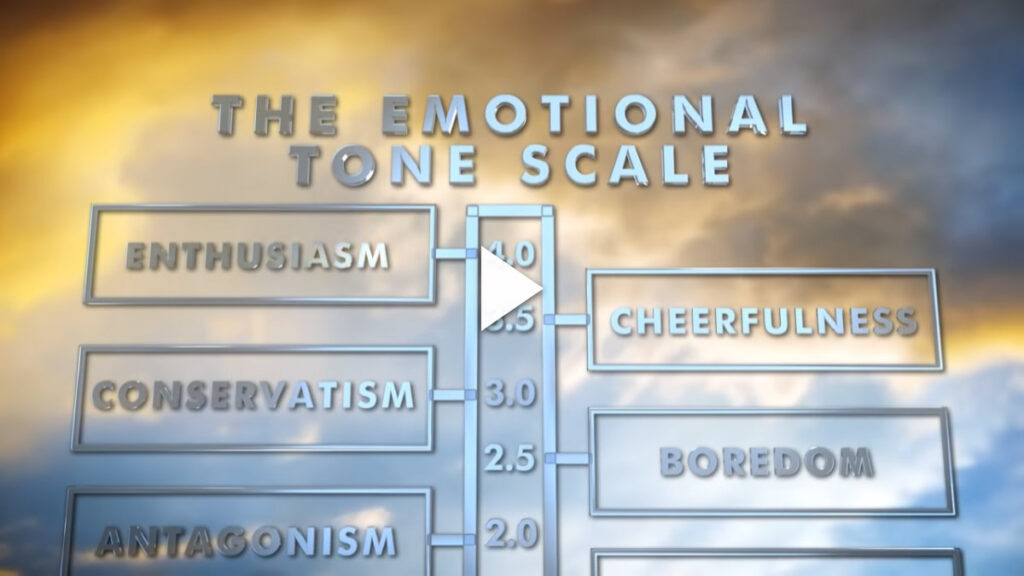
When you know the scale of emotions, it is possible to know the way people will act and can see how they behave in life. The Emotional Tone Scale The illustrated Tone Scale on this page shows you some of the most important tone levels that you will find in people. It goes from the emotional tone of serenity (a calm, peaceful state we can also call Happiness) at the very top down through Enthusiasm, Boredom, Antagonism, Anger, Fear, Grief and Apathy. Below that a person can be in the emotional tone of Body Death (he acts like he is actually dead or could actually be unconscious). You can use the Tone Scale to spot the emotional tone level of people that you live and work with, as well as anyone you are in contact with at any time. Being able to spot and know what tone level a person is in—either at that tone level for a brief period of time or always in that tone level—can help you predict how that person will behave when you communicate to him or interact with him. Use this scale to learn how to quickly and accurately spot the tone level of people around you. The Tone Scale And Understanding The tones of the Emotional Tone Scale are very exact. Every person on Earth is somewhere on the Emotional Tone Scale and he moves up and down the scale following its exact pattern. People always come up or go down through these tones, one after the other. The emotional tones are also called the tones of affinity. Affinity means love or liking, and it is used here as the idea of how much you like or dislike someone or something. You can easily see this if you take someone who is at the top of the scale. Someone in happiness has a lot of love or liking for other people. But a man in anger does not have much love or liking for anyone. There are many small stops between these tones, but anyone knowing anything about people should definitely know these emotions. When a person in apathy improves his tone, he feels grief. When a person in grief improves his tone, he feels fear. When a person in fear improves his tone, he feels anger. When a person in anger improves his tone, he feels antagonism. When a person in antagonism improves his tone, he feels boredom. When a person in boredom improves his tone, he feels enthusiasm. When a person in enthusiasm improves his tone, he feels serenity—or happiness. People can be in any tone continuously over a long period of time—grief, fear, anger, antagonism, boredom or even enthusiasm.
How To Communicate And Understand Others Better
A man is as dead as he can’t communicate. He is alive as he can communicate. From the book Dianetics 55! The Complete Manual of Human Communication by L. Ron Hubbard The Components Of Understanding
Financial Security

Now, if you think the money is the end of the effort, you’re making a bad mistake there too, because it actually is merely a representation of your creativeness, that’s all it is. It merely represents it in some fashion. And if your creativeness is good, you don’t have to worry about saving any money. Your best investment is your own skill and your ability to put things back together again, your ability to stand on two feet and live—that’s your best investment in the world. Excerpted from a lecture given by L. Ron Hubbard 10 February 1956 People have this idea of a job meaning security and it’s not security at all. The only secure person in a fluctuating society is one who has something of the entrepreneur, something of the entrepreneur. In other words, he must be able to put into existence business, action, commodity, money. He must be able to do something about it. He must have, himself, some control over money, commodity and other things before he, himself, can have any real security at all. Excerpted from the lecture Survival: Question and Answer Period by L. Ron Hubbard given on 12 March 1957
How Should We Treat Each Other?
Try To Treat Others As You Would Want Them To Treat You “In the unreal world of fiction and the motion pictures, one sees polite villains with unbelievably efficient gangs and lone heroes who are outright boors*. Life really isn’t like that: real villains are usually pretty crude people and their henchmen cruder; Napoleon and Hitler were betrayed right and left by their own people. Real heroes are the quietest-talking fellows you ever met and they are very polite to their friends. “When one is lucky enough to get to meet and talk to the men and women who are at the top of their professions, one is struck by an observation often made that they are just about the nicest people you ever met. That is one of the reasons they are at the top: they try, most of them, to treat others well. And those around them respond and tend to treat them well and even forgive their few shortcomings.” *Rough, bad-mannered person Excerpted from The Way to Happiness, A Common Sense Guide to Better Living by L. Ron Hubbard
On Marriage

Communication is the root of marital success from which a strong union can grow and non-communication is the rock on which the ship will bash out her keel. In the first place, men and women aren’t too careful on “whom they up and marry.” In the absence of any basic training about neurosis, psychosis or how to judge a good cook or a good wage earner, that tricky, treacherous and not always easy-to-identify thing called ‘love’ is the sole guiding factor in the selection of mates. …There are ways, however, not only to select a marriage partner, but also to guarantee the continuation of that marriage, and these ways are simple. They depend, uniformly, upon communication. There should be some parity of intellect and sanity between a husband and wife for them to have a successful marriage. In Western culture, it is expected that women shall have some command of the humanities and sciences. It is easy to establish the educational background of a potential marriage partner. It is not so easy to gauge their capability regarding sex, family or children, or their sanity. In Scientology, there is a test for sanity and comparative sanity which is so simple that anyone can apply it: What is the “communication lag” of the individual? When asked a question, how long does it take him to answer? When a remark is addressed to him, how long does it take for him to register and return? The fast answer tells of the fast mind and the sane mind, providing the answer is sequitur. The slow answer tells of downscale. Marital partners who have the same communication lag will get along. Where one partner is fast and one is slow, the situation will become unbearable to the fast partner and miserable to the slow one. It may be that another family factor is in the scene. This may be in the person of a relative, such as the mother-in-law. How does one solve this factor without using a shotgun? This, again, is simple. The mother-in-law, if there is trouble in the family, is responsible for cutting communication lines or diverting communication. One or the other of the partners, then, is cut off the communication channel on which he belongs. He sense this and objects strenuously to it. …Jealousy is the largest factor in breaking up marriages. Jealousy comes about because of the insecurity of the jealous person and the jealousy may or may not have foundation. This person is afraid of hidden communication lines* and will do anything to try to uncover them. This acts upon the other partner to make him feel that his communication lines are being cut, for he thinks himself entitled to have open communication line, whereas his marital partner insists that he shut many of them. The resultant rows are violent, as represented by the fact that where jealousy exists in a profession, such acting, insurance companies will not issue policies—the suicide rate is too high. *Communication lines: The routes along which communications (particles, messages, etc.) travel from one person to another.
How To Live With Children
The adult is the problem in child raising, not the child. An adult has certain rights around children which children and modern adults rather tend to ignore. A good, stable adult with love and tolerance in his heart is about the best therapy a child can have. Children are not dogs. They can’t be trained like dogs are trained. They are not controllable items. They are, and let’s not overlook the point, men and women. A child is not a special species of animal distinct from Man. A child is a man or a woman who has not attained full growth. Any law which applies to the behavior of men and women applies to children. How would you like to be pulled and hauled and ordered about and restrained from doing whatever you wanted to do? You’d resent it. The only reason a child ‘doesn’t’ resent it is because he’s small. You’d half murder somebody who treated you, an adult, with the orders, contradiction and disrespect give to the average child. Your child doesn’t strike back because he isn’t big enough. He gets your floor muddy, interrupts your nap, destroy the peace of the home instead. If he had equality with you in the matter of rights, he’d not ask for this “revenge”. This “revenge” is standard child behavior. It may be that another family factor is in the scene. This may be in the person of a relative, such as the mother-in-law. How does one solve this factor without using a shotgun? This, again, is simple. The mother-in-law, if there is trouble in the family, is responsible for cutting communication lines or diverting communication. One or the other of the partners, then, is cut off the communication channel on which he belongs. He sense this and objects strenuously to it. A child has a right to his self-determinism. You say that if he is not restrained from pulling things down on him, running into the road, etc., etc., he’ll be hurt. What are you, as an adult, doing to make that child live in rooms or an environment where he can be hurt? The fault is yours, not his, if he breaks things. The sweetness and love of a child is preserved only so long as he can exert his own self-determinism. You interrupt that and, to a degree, you interrupt his life. There are only two reasons why a child’s right to decide for himself has to be interrupted—the fragility and danger of his environment and you. For you work out on him the things that were done to you, regardless of what you think. There are two courses you can take. Give the child the leeway in an environment he can’t hurt, which can’t badly hurt him and which doesn’t greatly restrict his space and time. And you can clean up your own aberrations* to a point where your tolerance equals or surpasses his lack of education in how to please you. When you give a child something, it’s his. It’s not still yours. Clothes, toys, quarters, what he has been given must remain under his exclusive control. So he tears up his shirt, wrecks his bed, breaks his fire engine. It’s none of your business. How would you like to have somebody give you a Christmas present and then tell you, day after day thereafter, what you are to do with it and even punish you if you failed to take are for it the way the donor thinks? You’d wreck that donor and ruin that present. You know you would. The child wrecks your nerves when you do it to him. That’s revenge. He cries. He pesters you. He breaks your things. He “accidently” spills his milk. And he wrecks the possession on purpose about which he is so often cautioned. Why? Because he is fighting for his own self-determinism, his own right to own and make his weight felt on his environment. This “possession” is another channel by which he can be controlled. So he has to fight the possession and the controller. * aberrtion: a departure from rational thought or behavior. It means basically to err, to make mistakes, or more specifically to have fixed ideas which are not true. The word is also used in its scientific sense. It means departure from a straight line. If a line should go from A to B, then if it is aberrated it would go from A to some other point, to some other point, to some other point, to some other point, to some other point, and finally arrive at B. Taken in this sense, it would also mean the lack of straightness or to see crookedly as, for example, a man sees a horse but thinks he sees an elephant. Aberrated conduct would be wrong conduct, or conduct not supported by reason. When a person has engrams, these tend to deflect what would be his normal ability to perceive truth and bring about an aberrated view of situations which then would cause an aberrated reaction to them. Aberration is opposed to sanity, which would be its opposite. From the Latin, aberrare, to wander from; Latin, ab, away, errare, to wander.
Honest People Have Rights, Too
Freedom is for honest people. No man who is not himself honest can be free—he is his own trap.